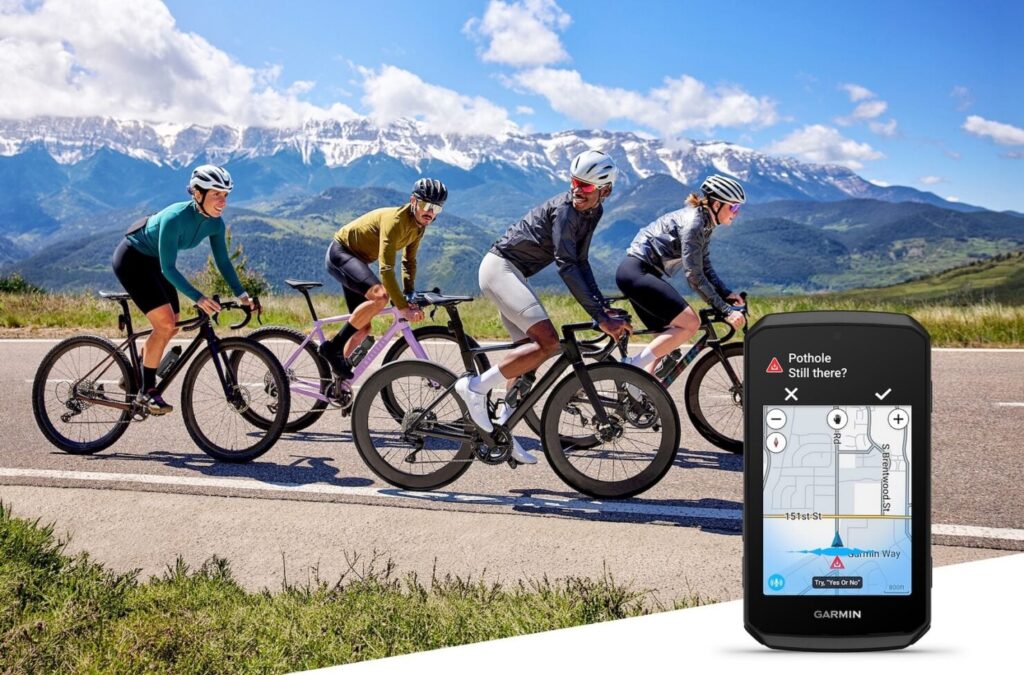
Garmin has introduced the Edge 1060, a premium cycling computer built around a simple idea: riders should be able to use more features without taking a hand off the bars. Announced on October 20, the new model adds a microphone, speaker and voice commands for navigation, performance data, hazard reporting and messaging.
The Edge 1060 is available now in the United States for $799.99. Garmin rates it for up to 20 hours of battery life in demanding use or up to 60 hours in battery-saver mode.
What voice control can do
Saying “Okay, Garmin” activates the Edge 1060’s voice system. Garmin says riders can ask for current statistics such as heart rate, request directions to a nearby point of interest, choose a route or report a pothole. The device can respond by changing the on-screen view, reading a statistic aloud or suggesting a route.
The built-in speaker also handles navigation and workout prompts and can work as a digital bicycle bell. With the on-device Garmin Messenger app and a connected smartphone, riders can record outgoing voice messages and hear incoming messages through the Edge.
This is useful in theory because cycling computers often require multiple screen taps at moments when a rider should be watching the road. Voice control will not remove every distraction, but it could reduce the need to interact with a touchscreen while moving.
New navigation and road-awareness tools
Garmin has expanded route planning beyond simply calculating the shortest path. Route Options compares choices using ride time, elevation and bike type, while Route Previews shows distance, estimated time, traffic and reported hazards before a ride begins.
An updated Up Ahead view highlights practical stops such as restrooms, coffee shops and gas stations. Free Flow Routing favors routes with fewer stops, intersections and slowdowns. The Edge 1060 can also display road closures and community-reported hazards including potholes, obstructions and aggressive animals.
Some of those connected features depend on a compatible smartphone and the Garmin Connect app. The value of community hazard data will also vary with how many Garmin cyclists are active in a particular area.
Training, GroupRide and reverse charging
The Edge 1060 retains Garmin’s performance-focused features, including real-time stamina, Power Guide, cycling ability and course-demand insights. Garmin Cycling Coach can create an adaptive plan, and TrainingPeaks workouts can sync automatically.
GroupRide detection can alert a rider when a nearby session is active. After joining, users can access messaging, live locations, incident alerts, competitions and awards. The workout screen is now interactive, and the home screen can be customized with preferred apps and widgets.
A reverse-charging feature can provide emergency power to a compatible Varia light, phone or another device through USB-C. Garmin specifically says it is not intended for charging another device while riding, so buyers should treat it as a stopped-roadside backup rather than a rolling power bank.
Important limitations
The $799.99 price places the Edge 1060 firmly in enthusiast territory. Garmin’s voice commands are available only in selected languages, and the company warns that recognition performance may vary with riding conditions. Wind, traffic and group noise are obvious real-world challenges, although Garmin has not published a controlled accuracy figure.
Two-way voice messaging requires a connected phone, and several safety and GroupRide functions also depend on a smartphone connection. Battery-life figures are manufacturer estimates rather than independent test results and will vary with display brightness, navigation, sensors and connected features.
Who is it for?
The Edge 1060 makes the most sense for frequent road, gravel or trail riders who already use Garmin sensors, GroupRide or structured training plans and want fewer touchscreen interactions. Casual riders mainly looking for basic navigation will find less expensive cycling computers easier to justify.
The most practical improvement is not a new training metric but the ability to request information and report hazards while keeping a grip on the handlebars. Whether that convenience is worth $799.99 will depend on how often a cyclist uses the deeper navigation and training tools.