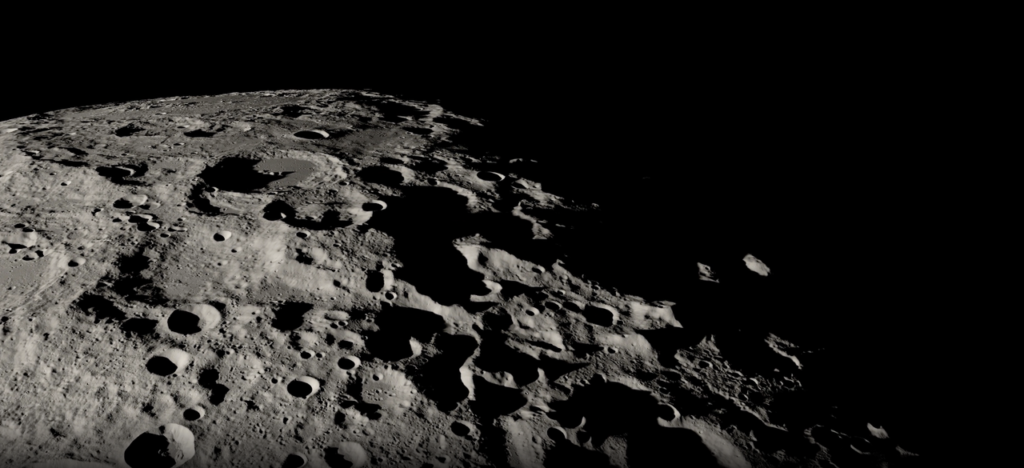
Hewlett Packard Enterprise plans to send a compact, fanless computer to the lunar south pole to test whether demanding AI and high-performance computing workloads can run directly on the Moon.
The newly announced Spaceborne Computer-4 is scheduled to travel as a payload on Astrolab’s FLIP rover. If the mission succeeds, HPE says the system will run the first high-performance computing benchmarks on the lunar surface, alongside language-model, computer-vision, LiDAR and cybersecurity experiments.
What Spaceborne Computer-4 is designed to do
Spaceborne Computer-4 is a lightweight, self-contained edge-computing module built for space environments. HPE says it combines a low-power CPU and GPU, flash storage supplied by Kioxia and a software stack designed to coordinate with Earth-based resources and return results securely.
The company has not disclosed the processor models, memory capacity, expected performance or power budget. It also has not announced a commercial price, because this is a mission payload rather than a consumer product.
Unlike a conventional server, the module has no cooling fans. That matters in the Moon’s vacuum, where moving air cannot carry heat away. HPE says the design is intended to survive the harsh environment near the lunar south pole, but real-world results will depend on the landing, deployment, thermal conditions and available rover power.
The mission route to the lunar south pole
HPE says the mission is intended to launch in late 2026 under NASA’s Commercial Lunar Payload Services initiative. Voyager Technologies’ Griffin-1 lander is expected to touch down near the lunar south pole and transport Astrolab’s FLIP rover, which will carry the computer.
That wording is important: the system is scheduled to fly, but it has not yet operated on the Moon. Lunar missions can be delayed or fail during launch, transit, landing or surface deployment. HPE’s “first” claim is also based on its analysis of publicly available plans as of October 20, 2026.
Benchmarks, AI and mapping workloads
The mission is expected to run High-Performance LINPACK and High-Performance Conjugate Gradient, two established benchmarks used to evaluate different parts of a computing system. HPL emphasizes dense linear algebra, while HPCG is designed to reflect memory access and communication patterns found in many scientific applications.
Those tests will show more than a headline performance number. They can help engineers understand how commercial computing components behave under lunar power, temperature and radiation constraints.
Planned AI work includes retrieval-augmented generation, visual-data analysis and autonomous monitoring. LiDAR processing will be tested for mapping, navigation, terrain analysis and infrastructure planning. Processing that data on the rover could reduce the amount of raw information that must be transmitted to Earth.
NASA and Deloitte are adding experiments
NASA plans to run an experiment called Federated Learning for Unbounded and Intelligent Decentralization, or FLUID. HPE says it will coordinate three neural-network models trained with data from Earth, the International Space Station and the Moon. NASA also plans to test a tuned language model for searching and interpreting documents stored onboard.
Deloitte’s Silent Shield system is expected to test predictive cyber analytics, anomaly detection and intrusion monitoring. Those capabilities could become important as future lunar equipment grows into a network of rovers, habitats, instruments and communications systems.
Why local computing matters on the Moon
A signal between Earth and the Moon takes roughly 1.3 seconds in one direction under ideal conditions. Operational delays can be longer once relays, processing and mission procedures are included. Bandwidth is also limited compared with terrestrial networks.
Local processing cannot remove every communication delay, but it can let a rover analyze images, summarize sensor data or flag an anomaly without waiting for a server on Earth. The same edge-computing idea is already useful in remote factories, ships and research stations; the lunar surface is a far more demanding test.
HPE has experience running commercial computer hardware aboard the International Space Station. Spaceborne Computer-4 extends that work from an inhabited orbital laboratory to an uncrewed rover operating on the Moon.
What remains unknown
HPE has not published complete hardware specifications, benchmark targets, mission duration or detailed radiation-hardening information. The announcement says the design uses a low-power CPU and GPU, but it does not identify the vendors or chips.
It is also too early to know how much science the computer will complete before environmental or power limits intervene. Benchmark results will matter more than promotional claims, especially because this payload is intended to demonstrate feasibility rather than deliver a finished lunar-computing platform.
The practical takeaway
Spaceborne Computer-4 is not simply a “supercomputer on the Moon” in the data-center sense. It is a small edge module intended to test whether useful HPC and AI work can be performed where lunar data is created.
If the mission reaches the surface and the experiments run as planned, the results could inform future rovers and lunar infrastructure that need faster local decisions, more autonomy and less dependence on constant high-bandwidth links to Earth.
Sources: HPE Newsroom (October 20, 2026); Tom’s Hardware (October 21, 2026).